

History:
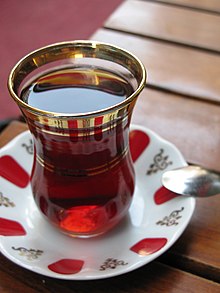
tea is an important part of Turkish culture, and is the most commonly consumed hot drink, despite the country’s long history of coffee consumption. Offering tea to guests is part of Turkish hospitality. Tea is most often consumed in households, shops, and by kıraathane – social gatherings of men. Despite its popularity, tea only became the beverage of choice in Turkey in the 20th century. It was initially encouraged as an alternative to coffee,[citation needed]which had become expensive and at times unavailable in the aftermath of World War I. Upon the loss of southeastern territories after the fall of the Ottoman Empire, coffee became an expensive import. At the urging of the founder of the republic, Atatürk, Turkish people turned more to tea as it was easily sustainable by domestic sources. Turkish tea is traditionally offered in small tulip-shaped glasses which are usually held by the rim, in order to save the drinker’s fingertips from being burned, as the tea is served boiling hot.
Preparation:
Turkish tea is typically prepared using two stacked kettles called “çaydanlık” specially designed for tea preparation. Water is brought to a boil in the larger lower kettle and then some of the water is used to fill the smaller kettle on top and steep (infuse) several spoons of loose tea leaves, producing a very strong tea.[2] When served, the remaining water is used to dilute the tea on an individual basis, giving each consumer the choice between strong (Turkish: koyu; literally “dark”, tavşan kanı (literally: rabbit’s blood) – a deep brownish red or weak (Turkish: açık; literally “light”). Tea is drunk from small glasses to enjoy it hot in addition to showing its colour, with cubes of beet sugar and without milk.
Turkish Herbal Teas:
In Turkey, herbal teas are generally used as herbal medication. They are mostly popular with foreign tourists[citation needed] with apple (elma çayı), rose hip (kuşburnu çayı), and linden flower (ıhlamur çayı) being the most consumed flavors. Sage tea (ada çayı, literally ‘island tea’) is most popular in the Mediterranean coastal region. In Turkey, herbal teas destined for the treatment of most ailments can be found in local herbal shops, called aktar. Dried herbal leaves, petals, shoots, etc. are sold in loose-leaf according to each customer’s need and taste.
 BatmanMakesTea